Guide · Updated September 23, 2026
Hydrogen Sulfide in Minnesota Well Water
Direct answer
Rotten-egg odor in a Minnesota well is hydrogen sulfide. Smell hot versus cold first. Bacteria or nitrate on the same sheet still goes to the county health department.
| What to test | Why | EPA MCL / SMCL or guidance |
|---|---|---|
| Odor / hydrogen sulfide | Rotten-egg smell. The nose often beats a mailed bottle; hot-only versus every tap is the first split. | 3 TON odor SMCL (aesthetic guideline) EPA secondary standards |
| Iron | Orange/brown stains and metallic taste. Dissolved iron, already-orange water, and slime are different jobs. | 0.3 mg/L SMCL (aesthetic guideline) EPA secondary standards |
| Total coliform | CDC’s annual floor for a private well. A present result is a pathway warning, not a shopping trip. | Present/absent — any detected coliform is a positive until a clean retest CDC well-testing guidelines |
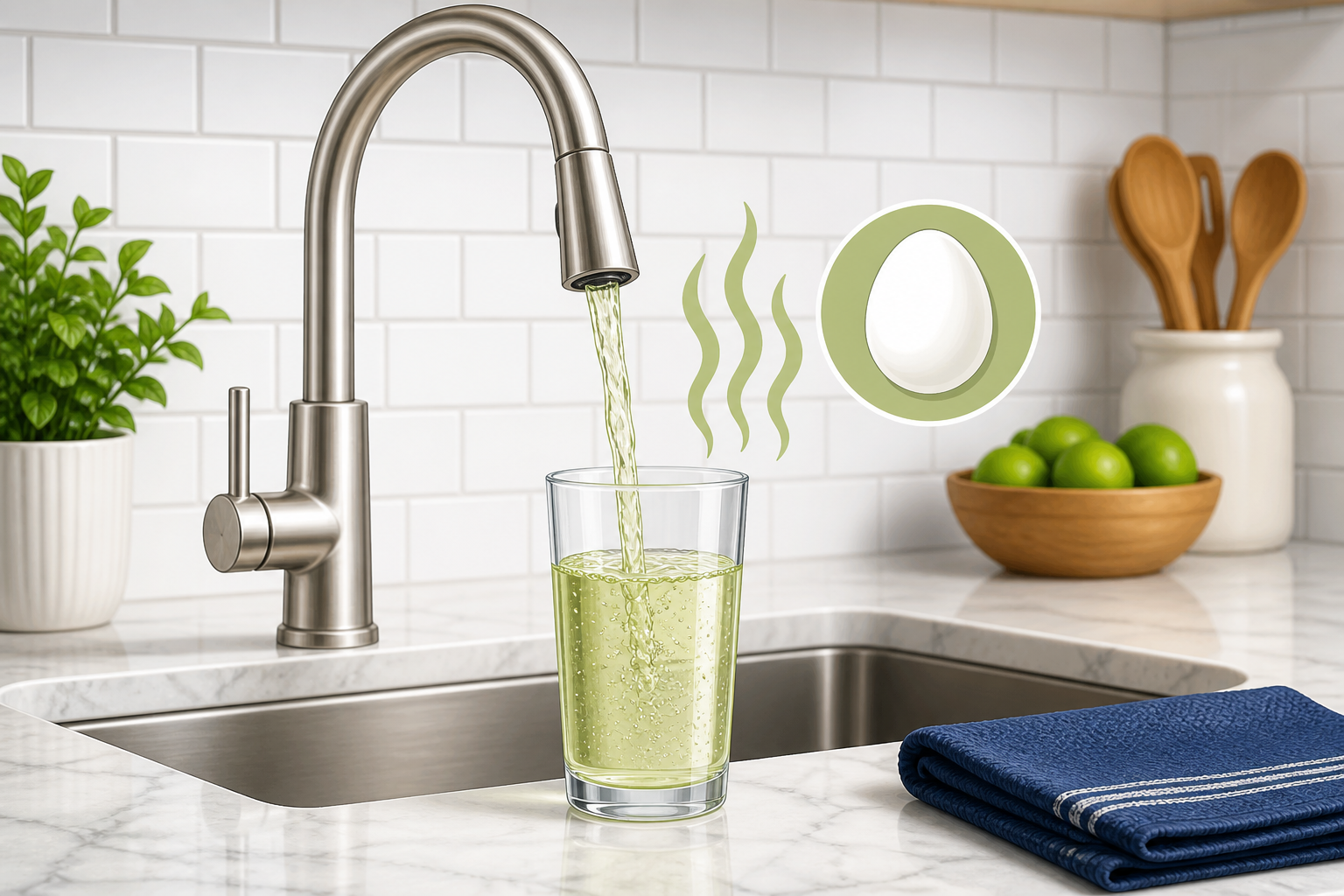
Smell first, then the split
A teaching diagram, not a customer kitchen. Hydrogen sulfide is a gas. The nose often beats a mailed bottle. MDH’s hydrosulfide page is the hot-versus-cold triage — not a diagnosis.
What you smell
Rotten egg
H₂S leaves a sample on the way to the bench. A metals bottle that arrives “ND” for sulfide does not overrule the nose. Field or preserved H₂S only if you need a number.
Hot only vs every tap
MDH / Penn State
Hot only: heater anode converting sulfate. Well, plumbing, or softener: sulfur bacteria / disinfection. Both taps and it stays: H₂S in the groundwater.
What EPA compares
Odor SMCL
EPA secondary standard: odor at 3 TON. There is no federal MCL for H₂S as a health-based drinking-water limit. Aesthetic. Not industrial gas exposure. Not a disease diagnosis.
If a Minnesota kitchen tap smells like a boiled egg, you are smelling hydrogen sulfide (H₂S). It is a gas. The nose often beats a mailed bottle. H₂S leaves the sample on the way to the bench. Minnesota Department of Health’s Why Does My Water Smell Like Rotten Eggs? page says the gas can occur in wells anywhere: natural decay and chemistry with soil and rock; sulfur bacteria in the groundwater, well, or plumbing; reactions inside a water heater; pollution (rare).
This page is the Minnesota long-tail of that split. It pairs with the sitewide rotten-egg smell guide and the Florida and Wisconsin sister pages. It is not a medical consult, not industrial gas exposure, and not a shopping list.
EPA’s secondary standards treat odor as an aesthetic issue (3 TON). There is no federal MCL for H₂S as a health-based drinking-water limit. MDH: sulfur bacteria themselves are not harmful, and in most cases the rotten-egg smell does not tell you whether the well is sanitary. Still test coliform and nitrate. If anyone in the house is ill, that is a clinician and a county health department — not a carbon tank.
Private wells are unregulated. MDH’s Well Testing, Results, and Options page, EPA’s private-wells pages, and CDC’s well-testing guidance put the schedule on the owner. Nobody mails you a Consumer Confidence Report.
MDH also says H₂S in the air can be harmful at high levels in low-lying or enclosed spaces — well pits, basements, well houses. Vent the gas. Only well professionals with proper precautions enter those spaces. That is a contractor safety note, not a kitchen-tap diagnosis and not an industrial exposure consult.
Smell hot versus cold first
MDH: after you have been away a few hours, smell hot and cold. That split names the class.
- Hot only, cold clean. The problem is likely in the water heater. MDH and Penn State Extension’s Common Drinking Water Problems table say the same thing: a magnesium sacrificial anode can convert sulfate to H₂S. A plumber can swap to aluminum per the heater manufacturer. Yanking the anode with no replacement can shorten tank life or void a warranty. Do that experiment before you buy a whole-house sulfur system for a heater problem.
- Well, plumbing, or softener. MDH: disinfect with a strong chlorine solution — licensed well contractor, or MDH’s well-disinfection instructions. Sulfur bacteria are hard to clear once they are in the well; iron bacteria slime makes it worse. If the odor is only after a softener, call the installer. A softener is already the wrong class for sulfur.
- Both taps, it stays. MDH: H₂S in the groundwater. That is a treatment-class or new-well conversation after the rest of the sheet.
The sitewide rotten-egg page is the three-source version of this split. Use both.
Look for MDH’s other clues: white, grey, black, or rusty slime (sulfur bacteria, sometimes with iron bacteria); black stains on silverware and fixtures; corroded metal. Clues. Not a milligram.
Confirm it without kidding yourself
- Smell cold, then hot, then a raw-water hose bib if you have one.
- Note whether the odor is only after an overnight sit.
- Look in the toilet tank for slime.
- Ask an MDH-accredited lab for iron, manganese, pH, sulfate, hardness, and the annual coliform / nitrate pair. Iron in Minnesota Well Water and Manganese in Minnesota Well Water often travel with sulfur.
- If you need a number on H₂S, use a field kit or a lab bottle with the right preservative. A standard metals bottle that arrives “ND” for sulfide does not overrule your nose.
MDH’s Sulfate in Well Water page is the related chemistry: sulfate occurs naturally, often higher in western Minnesota; above 250 mg/L it can taste bitter or medicinal and can corrode copper. Softeners and carbon do not remove sulfate. Sulfate in the heater is how a magnesium anode makes hot-only H₂S. This site will not turn a sulfate mg/L into a personal risk score.
Start at this site’s Minnesota certified-lab inventory. Open MDH Search for Accredited Laboratories (ELDO; health.state.mn.us/labsearch). Accreditation is by analyte. A coliform certificate is not a sulfide certificate. Then call about bottles. Lab news: /labs/minnesota/news. How to read a well water lab report is the decoder. Circle coliform and nitrate first.
A store kit is a screen. Well water test kits explains that split. Tap Score / SimpleLab is an approved class example of a mail-in certified-lab kit — not a ranked pick. Pair it with /labs/minnesota. It will not hold H₂S the way your nose does. Bacteria or nitrate on the same sheet still goes to the county health department. See the disclosure.
If you treat, MDH wants the bottle after treatment — the tap you cook and drink from — unless you also need a raw-side number. Ask for a second bottle if you need both.
Treatment classes by situation
Name the class after the hot/cold split and the sheet. Then look a model up in the NSF drinking-water treatment-unit database. NSF is a claim on a listed model (often Standard 42 for aesthetic taste/odor), not a badge this site awards. This page does not rank catalogs.
MDH’s hydrosulfide page and the English PDF brochure name the usual classes. MDH’s GAC filter page adds that carbon can take H₂S odor — and does not take iron or nitrate.
| Situation | Class that matches | Class that usually fails |
|---|---|---|
| Hot only, cold clean | Anode change / heater service | Whole-house oxidizer |
| H₂S below 1 mg/L, no iron, no slime | Activated carbon (GAC). Service life is unpredictable — weeks to years | Pitcher filter as the only tank |
| Below or above 1 mg/L | Oxidizing media (MDH names manganese greensand, about up to 6 mg/L), aeration + filtration, continuous chlorination + filtration, ozonation + filtration | Softener |
| H₂S plus iron or manganese | Air or chemical oxidation, then filtration | Carbon alone |
| Slime in the well or softener | Licensed well contractor / disinfection first | A taller “sulfur filter” |
A softener is the wrong class for sulfur. Resin fouls on sulfide and iron. Iron filter vs. water softener is the trap page. Whole-house iron and sulfur filters is the oxidation-class catalog. Treatment order after the pressure tank still applies: sediment, then oxidation, then softener last.
Hire a licensed plumber or licensed water-conditioning contractor (Minnesota Department of Labor and Industry license lookup). Questions: MDH Well Management, 651-201-4600 or 800-383-9808, health.wells@state.mn.us.
Manufacturer sites are catalogs, not rankings. SpringWell, US Water Systems, and Pelican: official URLs, labeled application pending. SoftPro is an approved iron/sulfur catalog link (see disclosure):
- SpringWell — well/sulfur packages (application pending)
- US Water Systems — air and chemical options (application pending)
- SoftPro — iron/sulfur filters (not softeners)
- Pelican — (application pending)
If coliform is present, stop. Health department first. Shock chlorination is a sanitation step, not a sulfur subscription.
What to do this week
- Smell hot versus cold, then a raw tap if you have one.
- If it is hot-only, call a plumber about the anode before you shop a tank.
- Open /labs/minnesota. Order iron, manganese, pH, sulfate, hardness, and the annual coliform/nitrate pair. Field/preserved H₂S only if you need a number.
- If coliform or nitrate is flagged, call the county health department before you shop a sulfur stage.
- Only after the split and the sheet: pick the class — anode, carbon under 1 mg/L, oxidizing media / aeration / chlorination / ozonation — then NSF lookup. Not a softener.
Bottom line
Rotten-egg odor in a Minnesota well is hydrogen sulfide. The nose is the first instrument. MDH’s hydrosulfide page is the hot-versus-cold triage. EPA has an odor secondary standard (3 TON) and no H₂S MCL. Order the rest of the sheet from the Minnesota inventory. Fix the anode if that is the whole story. If the cold water stinks, match an oxidizer class — carbon only when the number is under 1 mg/L. A softener is the wrong class. Bacteria and nitrate still go to the health department. See the disclosure for affiliate status.
Updated 2026-09-23.
State pages and the labs hub
Related
Sources
- 1.Minnesota Department of Health. Why Does My Water Smell Like Rotten Eggs? Hydrogen Sulfide and Sulfur Bacteria in Well Water.
- 2.Minnesota Department of Health. Hydrogen Sulfide and Sulfur Bacteria in Well Water (PDF brochure).
- 3.Minnesota Department of Health. Sulfate in Well Water.
- 4.Minnesota Department of Health. Water Treatment Using Carbon Filters: GAC Filter Information.
- 5.Minnesota Department of Health. Well Testing, Results, and Options.
- 6.Minnesota Department of Health. Search for Accredited Laboratories (ELDO).
- 7.U.S. EPA. Secondary Drinking Water Standards: Guidance for Nuisance Chemicals.
- 8.U.S. EPA. Private Drinking Water Wells.
- 9.Penn State Extension. Common Drinking Water Problems and Solutions.
- 10.NSF. Search NSF Certified Drinking Water Treatment Units.