Guide · Updated October 17, 2026
Why does my well water smell like rotten eggs?
Direct answer
A boiled-egg smell on a private well is hydrogen sulfide. Smell hot versus cold first. Hot-only is often the water-heater anode. A cold-tap odor is the well, and H2S often leaves a mailed bottle. Get iron, manganese, coliform, and nitrate at a certified lab. Coliform or nitrate still goes to the local health department.
| What to test | Why | EPA MCL / SMCL or guidance |
|---|---|---|
| Odor / hydrogen sulfide | Rotten-egg smell. The nose often beats a mailed bottle; hot-only versus every tap is the first split. | 3 TON odor SMCL (aesthetic guideline) EPA secondary standards |
| Iron | Orange/brown stains and metallic taste. Dissolved iron, already-orange water, and slime are different jobs. | 0.3 mg/L SMCL (aesthetic guideline) EPA secondary standards |
| Manganese | Black-brown stains and dark grit. Not the same tank as hardness. | 0.05 mg/L SMCL (aesthetic guideline) EPA secondary standards |
| Total coliform | CDC’s annual floor for a private well. A present result is a pathway warning, not a shopping trip. | Present/absent — any detected coliform is a positive until a clean retest CDC well-testing guidelines |
| Nitrate as N | Same yearly panel as coliform. A result at or above the public-system line goes to the health department. | 10 mg/L as N (EPA public-system MCL) EPA National Primary Drinking Water Regulations |
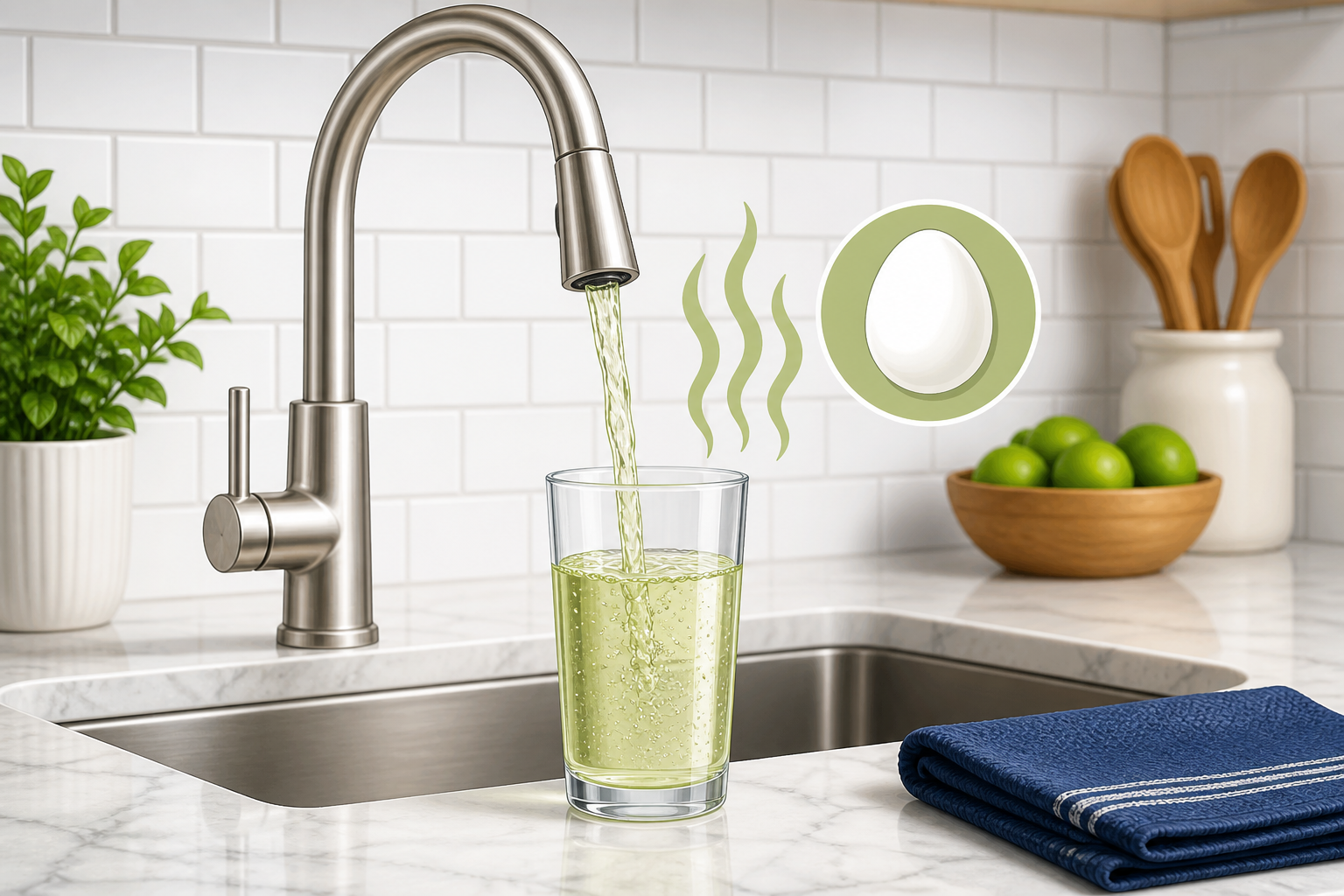
If the water smells like a boiled egg, you are smelling hydrogen sulfide (H2S). The nose is better than most mailed lab reports. H2S is a gas. It leaves a sample bottle on the way to the bench. Penn State Extension’s hydrogen-sulfide bulletin is the document to keep open: the gas is common in low-oxygen groundwater, especially in shale and sandstone; sulfur-reducing bacteria make it; and a magnesium anode in the water heater can make it only on the hot side.
EPA’s secondary standards treat odor as an aesthetic issue (3 TON). There is no federal MCL for H2S in drinking water. This page is about plumbing, taste, and treatment class, not about industrial gas exposure, and not about diagnosing disease. If anyone in the house is ill, that is a clinician and a health department, not a carbon tank.
Steps
- Smell a cold kitchen tap, then a hot tap, then an untreated hose bib if you have one. Hot-only usually points at the water-heater anode. Cold-tap odor points at the well.
- Look in the toilet tank for slime. Jelly plus an egg smell is often sulfur or iron bacteria. That is slimy toilet tank, not a carbon pitcher.
- Order a certified-lab panel: iron, manganese, pH, sulfate, hardness, and the yearly coliform and nitrate pair. Start at certified labs by state.
- If coliform is present, or nitrate is at or above 10 mg/L as N, stop shopping tanks. Take the sheet to the local health department.
- Match a treatment class to the source. An anode change is not an oxidizer. An oxidizer is not a softener. See iron filter vs. water softener.
When to test
CDC’s private-well floor is total coliform, nitrates, total dissolved solids, and pH at a state-certified lab, and again after a change in taste, smell, or look. EPA’s private-well pages put the same owner-testing job on the household. Test also after floods, after well or heater work, and when the odor moves from hot-only to every tap. A mailed H2S bottle can come back “ND” while the tap still stinks. Smell first. For a number, use a field kit or a lab bottle with the right preservative.
Three sources, three fixes
1. Hot water only
Penn State’s first cheap experiment: the magnesium sacrificial anode in many heaters can reduce sulfate to H2S. Smell at the shower, not at the cold kitchen tap. A plumber can replace the anode with aluminum or zinc aluminum per the heater manufacturer. Removing the anode altogether can void a warranty and shorten the tank. Do that experiment before you buy a whole-house sulfur system for a heater problem.
2. Cold and hot, worse after the water sits
Aquifer H2S or bacteria in the well and plumbing. Smell at an untreated hose bib if you have one. Often travels with iron and manganese because the same reducing chemistry dissolves all of them.
3. Slimy, swampy, or cucumber-plus-egg
Sulfur bacteria and iron bacteria like the same wells. Minnesota Department of Health’s iron-bacteria page is about slime and clogging. Penn State’s related bulletin on iron and sulfur bacteria describes musty or petroleum-like odors and dark slime. A carbon filter on that water is a snack bar.
Where to get the test
Start at certified labs by state. Use a state-certified drinking-water lab, not a store strip, for the coliform and nitrate pair and for iron and manganese. State inventories that already have a hydrogen-sulfide guide: Florida, Minnesota, and Wisconsin. The same official-search path now covers Michigan, North Carolina, New York, and New Hampshire. The Florida, Minnesota, and Wisconsin smell pages are Hydrogen Sulfide in Florida Well Water, Hydrogen Sulfide in Minnesota Well Water, and Hydrogen Sulfide in Wisconsin Well Water.
EPA’s secondary odor number is 3 TON. There is still no federal MCL for H2S. Iron’s aesthetic line is 0.3 mg/L; manganese’s is 0.05 mg/L. Those are public-system SMCLs, teaching numbers, not a kitchen-tap statute. A present coliform or a nitrate at or above 10 mg/L as N still goes to the local health department.
Treatment classes by situation
| Situation | Class that matches | Class that usually fails |
|---|---|---|
| Hot only, cold clean | Anode change / heater service | Whole-house oxidizer |
| Low H2S, no iron, no slime | Catalytic carbon with oxygen or a small air-injection carbon | Pitcher filter |
| H2S plus iron/manganese | Air injection or chemical oxidation, then filtration | Softener |
| Strong odor, high iron, bacteria slime | Chlorine or peroxide injection, contact tank, filtration, carbon polish; well cleaning | “Sulfur filter” the size of a fire extinguisher |
| Odor after a new well or flood | Retest bacteria; inspect the cap and grout; contractor | More salt |
Catalytic carbon needs oxygen and conservative loading. It is not a magic rock. Air-injection systems need a well that can waste water on backwash and a drain that can take it. Chemical feed needs a pump that is maintained.
NSF listings: look for aesthetic chlorine, taste, and odor claims (42) and, if a unit claims something health-related, the matching standard. H2S claims are inconsistent across consumer brands. The chemistry still has to match the milligrams.
You are turning dissolved sulfide into a form you can filter or vent, and you are often oxidizing iron at the same time. That is why a combined iron and sulfur filter is a real class and a “softener for sulfur” is not. Softener resin fouls on sulfide and iron.
Chlorine residual that is left on purpose is a disinfection choice. Continuous chlorination is a different decision from a one-time shock. If you need disinfection because of bacteria, the health department sets the terms.
The well and the contractor
If the odor arrived after a pump job, someone may have introduced bacteria. If the well is old, shallow, or missing a sanitary cap, treatment in the basement is a subscription to the same smell. NGWA’s contractor lookup finds members; your state license list finds people allowed to pull the pump. Use both.
A waterlogged pressure tank can make odors worse by giving bacteria a stagnant bladder-side party. Check the tank if the pump short-cycles. That is its own guide.
Comparing boxed systems
Manufacturer catalogs, not rankings. SpringWell, US Water Systems, and Pelican: official URLs, application pending. SoftPro: tracked catalog link (see disclosure):
- SpringWell: well/sulfur packages
- US Water Systems: air and chemical options
- SoftPro: iron/sulfur filters (not softeners)
- Pelican
Well Diagnosis may earn a commission if you buy through an approved affiliate link on this page. That does not change the price you pay. See the disclosure.
Read the fine print for maximum H2S and iron, pH range, and backwash. If the site leads with lifestyle photography and no milligrams, keep walking.
Bottom line
Smell hot versus cold first. Fix the anode if that is the whole story. If the cold water stinks, test iron, manganese, and bacteria at a certified lab, measure H2S on site if you need a number, and pick an oxidizer class, not a softener, not a pitcher. Penn State already wrote the odor bulletin. This page exists so you do not buy a tank for the wrong source.
FAQ
- Why does my well water smell like rotten eggs?
- A boiled-egg smell on a private well is hydrogen sulfide. Smell hot versus cold first. Hot-only is often the water-heater anode. A cold-tap odor is the well, and H2S often leaves a mailed bottle. Get iron, manganese, coliform, and nitrate at a certified lab. Coliform or nitrate still goes to the local health department.
- Why does my well water smell like sewage?
- A sewage or swampy odor can be sulfur bacteria, a septic pathway, or hydrogen sulfide that is not a clean boiled-egg smell. Minnesota Department of Health’s iron-bacteria page and Penn State’s iron and sulfur bacteria bulletin both describe musty or petroleum-like odors and dark slime. Test coliform and nitrate first. If either line fails, take the sheet to the local health department.
- Does a rotten-egg smell mean the well is unsafe?
- EPA treats odor as an aesthetic secondary standard (3 TON). There is no federal MCL for hydrogen sulfide in drinking water. The smell does not replace a bacteria or nitrate test. CDC still wants a yearly certified-lab coliform and nitrate pair, and a new test after a change in smell. A present coliform still goes to the health department.
- How do I get rid of the rotten-egg smell in well water?
- Match the source first. Hot-only is usually an anode change, not a whole-house tank. Cold-tap H2S with iron or manganese wants an oxidizer class, not a softener. Slime wants a bacteria look and often well cleaning. Official lab and health-department paths come first. SoftPro is a class example of an iron and sulfur filter, not a ranked pick.
State pages and the labs hub
Related
Sources
- 1.Penn State Extension. Hydrogen Sulfide (Rotten Egg Odor) in Water Wells.
- 2.U.S. EPA. Secondary Drinking Water Standards: Guidance for Nuisance Chemicals.
- 3.U.S. EPA, Private Wells. Protect Your Home’s Water.
- 4.Minnesota Department of Health. Iron Bacteria in Well Water.
- 5.NSF. Search NSF Certified Drinking Water Treatment Units.
- 6.Wellowner.org / National Ground Water Association. Find a Contractor.