Guide · Updated October 14, 2026
Iron filter vs. water softener
Direct answer
A water softener is for hardness. An iron filter is for iron — and usually manganese. One tank can nibble clear-water ferrous iron under about 1 mg/L. Colored water, slime, sulfur, or iron over about 2 mg/L needs an oxidizer first, then a softener last if the water is still hard. Get certified-lab iron, manganese, and hardness before anyone sells a tank. Bacteria or nitrate still goes to the local health department.
| What to test | Why | EPA MCL / SMCL or guidance |
|---|---|---|
| Iron | Orange/brown stains and metallic taste. Dissolved iron, already-orange water, and slime are different jobs. | 0.3 mg/L SMCL (aesthetic guideline) EPA secondary standards |
| Manganese | Black-brown stains and dark grit. Not the same tank as hardness. | 0.05 mg/L SMCL (aesthetic guideline) EPA secondary standards |
| Hardness as CaCO3 | White scale and soap that will not lather. There is no federal SMCL for hardness. | No federal SMCL — extension rule of thumb starts “hard” near 120 mg/L EPA private wells |
| Total coliform | CDC’s annual floor for a private well. A present result is a pathway warning, not a shopping trip. | Present/absent — any detected coliform is a positive until a clean retest CDC well-testing guidelines |
| Nitrate as N | Same yearly panel as coliform. A result at or above the public-system line goes to the health department. | 10 mg/L as N (EPA public-system MCL) EPA National Primary Drinking Water Regulations |
The most expensive sentence in a well-equipment catalog is “this softener also removes iron.” Sometimes it is true at 0.5 mg/L of clear-water ferrous iron and a dealer who services the resin. Often it is a way to sell one tank for two problems. The problems are different. Orange on porcelain is the stain page — orange stains in well water — not a softener brochure.
Hardness is mostly calcium and magnesium. It leaves white or gray scale on heating elements, glass, and fixtures. Iron is a metal that stains orange or brown at 0.3 mg/L — EPA’s secondary standard — and wrecks laundry. USGS Circular 1332 found both aesthetic metals and hardness to be common in U.S. domestic wells. Having both in the same kitchen is normal. Treating both with the same cation-exchange bed is the part people regret. Get the numbers from a state-certified lab — certified labs by state — before anyone sizes a tank.
What each device actually is
A water softener (NSF/ANSI 44 when certified) is a cation-exchange resin that trades calcium and magnesium for sodium or potassium. It regenerates with salt brine. It does not oxidize anything. It does not kill bacteria. It does not add alkalinity. It will not fix rotten-egg odor except by accident if the odor was something else.
An iron filter is a family, not a SKU. Common classes:
- Oxidizing media (manganese dioxide, greensand-type, catalytic coatings) that help turn dissolved iron into particles, then filter them, then backwash.
- Aeration / air-injection tanks that add oxygen, then filter.
- Chlorine or peroxide injection plus contact time plus carbon or catalytic media — used when iron is high, sulfur is present, or bacteria is in the picture.
- Birm and similar media that need dissolved oxygen and a cooperative pH.
NSF/ANSI 42 covers many aesthetic claims. Look up the model, not the brand family, in the NSF DWTU database.
When a softener can nibble iron
Resin will exchange some Fe²⁺. Manufacturers publish iron limits — often 1 to 3 mg/L — with footnotes: clear water, no ferric, no iron bacteria, pH in range, enough hardness so the bed regenerates as designed, and frequent regeneration so iron does not sit. Ignore the footnotes and the resin turns into a rusty, smelly brick that no amount of extra salt fixes.
If your untreated iron is under about 1 mg/L, water is clear at the tap, the toilet tank is not slimy, and hardness is the main complaint, a softener rated for iron plus a sediment prefilter can be a honest single-tank design. Get the iron number from a certified lab, not from a demo kit on the kitchen island.
If iron is over 2 mg/L, the water is already colored, or iron bacteria slime is visible, a softener is the wrong first tank. Minnesota Department of Health’s iron-bacteria page is about wells and disinfection, not salt settings. Jelly in the toilet tank is a biofilm job — slimy toilet tank — then an oxidizer. The state iron sheets that already exist are Iron in Minnesota Well Water and Iron in Wisconsin Well Water.
When you need both
Very hard water plus staining iron is a two-step job:
- Remove or oxidize iron and manganese.
- Soften what is left.
Put the softener first and the iron coats the resin. Put a cheap “iron filter” that is actually a softener with a different jacket sticker and you have not changed the chemistry.
Manganese likes to travel with iron. A softener is even worse at manganese than at iron. If Mn is over the 0.05 mg/L SMCL, assume you need an oxidizer, not a salt setting. Penn State Extension’s iron-and-manganese page says the same split: oxidation plus filtration for the metals, softening for hardness, and not one tank as a synonym. A whole-house oxidizer class lives on whole-house iron and sulfur filters.
Decision table
| Lab sheet | First class | Second class |
|---|---|---|
| Hardness > 120 mg/L as CaCO3, iron < 0.3, no slime | Softener | None |
| Hardness high, iron 0.3–1, clear, no slime | Softener rated for iron or small iron filter then softener | Optional |
| Iron > 1, or colored water | Iron/manganese oxidizer + filter | Softener if still hard |
| Iron or Mn plus H2S odor | Combined oxidizer sized for sulfur | Softener last if needed |
| Slime in toilet tank | Well sanitation, then oxidizer | Softener only after iron is gone |
| pH < 6.5 plus iron | Neutralizer / alkalinity plan with the iron step — order is site-specific | Softener after metals |
pH is the silent wrecker. Many iron media want pH at or above ~6.8. A calcite tank in the wrong place will cement itself with iron. Read treatment order after the pressure tank before you stack vessels.
Flow rate is a spec, not a vibe
Iron filters are limited by square inches of bed and by backwash. A 1-inch meter and a 10-inch tank that looked fine on a municipal house will channel on a 12 gpm well with three showers. Softeners have the same physics plus a brine draw that fails if the drain is a garden hose uphill.
Ask for:
- Service flow at the iron concentration you actually have
- Backwash flow your well can deliver
- Drain provisions
- What happens when iron is 50% higher than the quote
If the well cannot supply backwash, you need a different class (or a cistern of backwash water), not a bigger promise.
Salt, iron, and the drain
Softening high-TDS water adds sodium. That is a taste and, for some households, a dietary issue — talk to a clinician, not this site. It is also a septic-load issue in small systems. An iron filter that backwashes rust into a weak drain will stain the ditch and annoy a neighbor. None of that is solved by buying the brand that advertises hardest.
How to compare systems
- Write iron, manganese, hardness, pH, H2S (field), bacteria status on one card.
- Pick the class from the table.
- Open manufacturer sites as catalogs, not as oracles. SoftPro is the approved iron-filter catalog on this page (see disclosure): SoftPro. Pelican, Kinetico, and Pentair stay official URLs, labeled application pending: Pelican, Kinetico, Pentair. Well Diagnosis may earn a commission if you buy through an approved affiliate link on this page. That does not change the price you pay.
- Check the model in NSF’s DWTU search.
- If the well itself is dirty or the pump short-cycles, fix that first. NGWA contractor lookup plus your state license list.
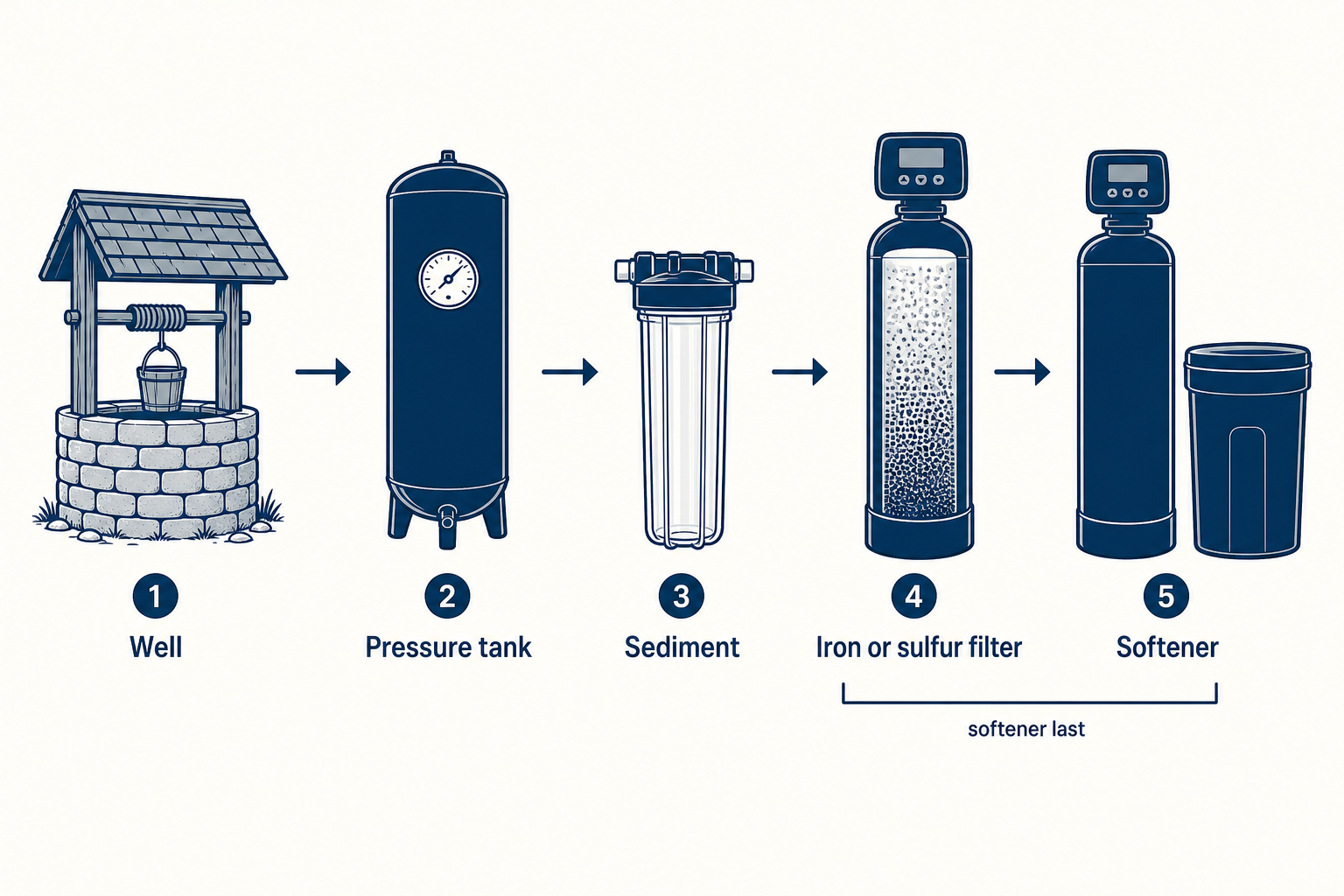
EPA’s private-well pages will not pick a brand. They will tell you to test. That is the correct order. After the sheet, stack vessels in treatment order after the pressure tank: sediment, then the iron or sulfur job, then the softener last.
Bottom line
A softener is for hardness. An iron filter is for iron (and usually manganese). One tank can cover a thin overlap of clear-water iron. Slime, colored water, sulfur, and high metals need oxidation or well work. If a quote uses “softener” and “iron filter” as synonyms, get another quote.
State pages and the labs hub
Related
Sources
- 1.U.S. EPA. Secondary Drinking Water Standards: Guidance for Nuisance Chemicals.
- 2.U.S. Geological Survey. Quality of Water from Domestic Wells in Principal Aquifers of the United States, 1991–2004 (Circular 1332).
- 3.NSF. Search NSF Certified Drinking Water Treatment Units.
- 4.Wellowner.org / National Ground Water Association. Find a Contractor.
- 5.U.S. EPA, Private Wells. Protect Your Home’s Water.
- 6.Minnesota Department of Health. Iron Bacteria in Well Water.
- 7.Penn State Extension. Iron and Manganese in Private Water Systems.