Guide · Updated August 30, 2026
Treatment order after the pressure tank
Direct answer
House tanks go after the pressure tank, in order: sediment, then oxidation or neutralization if the sheet says so, then softening, then carbon, then UV last. The wrong stack is how a new system fails in a month.
| What to test | Why | EPA MCL / SMCL or guidance |
|---|---|---|
| Total coliform | CDC’s annual floor for a private well. A present result is a pathway warning, not a shopping trip. | Present/absent — any detected coliform is a positive until a clean retest CDC well-testing guidelines |
| Nitrate as N | Same yearly panel as coliform. A result at or above the public-system line goes to the health department. | 10 mg/L as N (EPA public-system MCL) EPA National Primary Drinking Water Regulations |
| pH | CDC annual floor. Low pH is a corrosion clue, not an iron-filter job. | 6.5–8.5 SMCL (aesthetic guideline) EPA secondary standards |
| Total dissolved solids | CDC annual floor with coliform, nitrate, and pH. | 500 mg/L SMCL (aesthetic guideline) EPA secondary standards |
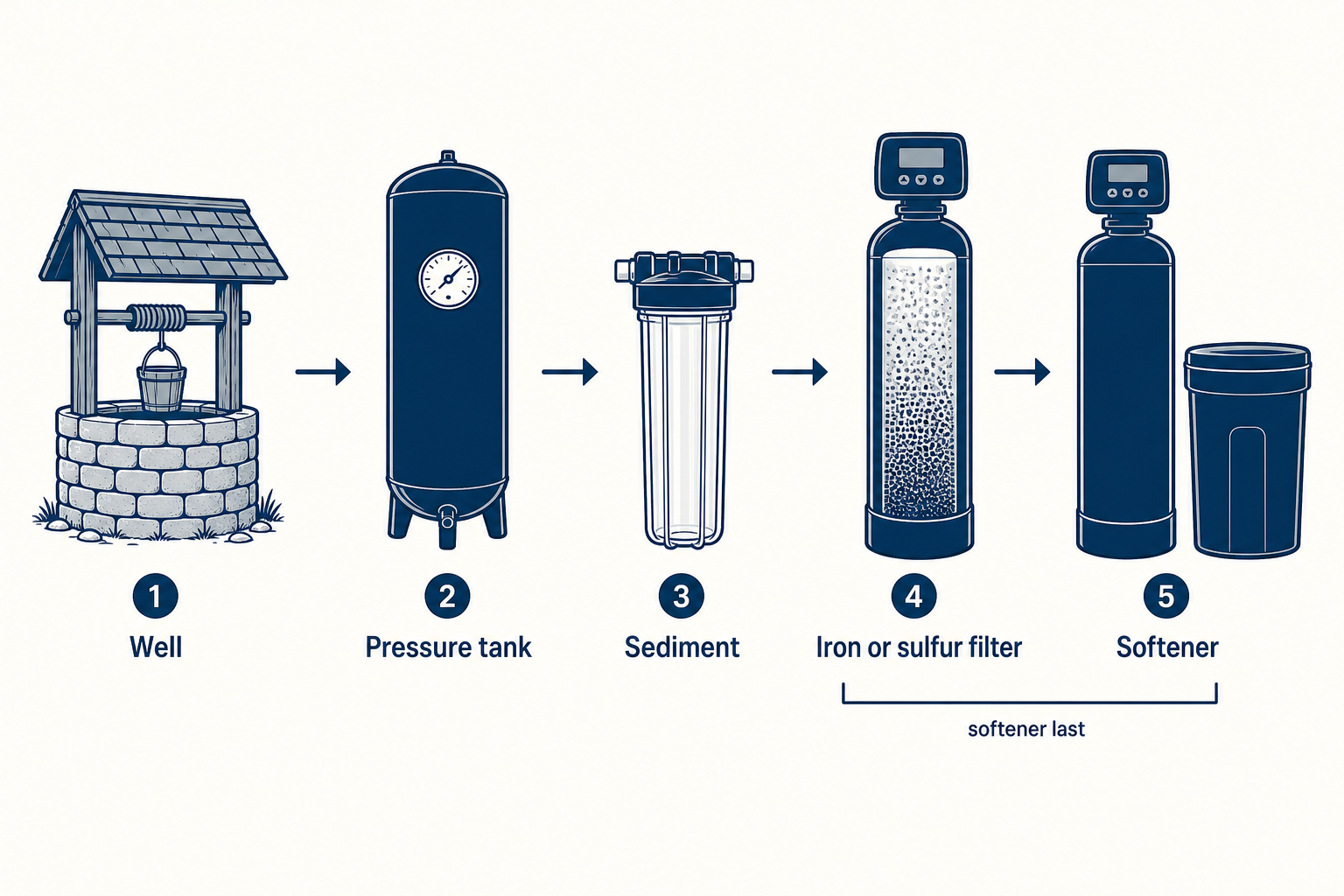
Treatment equipment is almost always installed after the pressure tank. The tank is the last piece of the well system. Everything downstream is house plumbing. If you put a filter before the tank, you fight well-pump flow, you complicate backwash, and you service a device that sees every sand grain the borehole still makes. After the tank, you see a somewhat steadier line — if the tank is not waterlogged.
Order among the house tanks is where good chemistry goes to die. Iron on a softener resin. UV on rusty water. A calcite neutralizer cemented by iron. Carbon first so it eats the chlorine you needed for sulfur. This page is the stack, not a brand ranking.
The default sequence
- Bypass and sample taps. You need an untreated hose bib and a way to isolate each vessel. If you cannot sample raw water, you cannot tell whether the well or the tank farm failed.
- Sediment / spin-down / cartridge if the water carries sand or grit. Protects valves. A cartridge is not an iron filter.
- Oxidation and filtration for iron, manganese, and hydrogen sulfide. Air, catalytic media, or chemical feed — see whole-house iron and sulfur filters. This step wants the metals while they are still the well’s problem, not the softener’s.
- pH / alkalinity adjustment when the water is corrosive (low pH, copper stains, pinholes). Calcite, magnesia, or soda-ash feed. Iron and low pH together need a plan: some designs raise pH so iron media works; some remove iron first so calcite does not foul. That is the main exception to a printed recipe. Get it in writing from someone who has done both in your geology.
- Softener for hardness, after iron and manganese are down. Iron filter vs. softener.
- Carbon to remove chlorine after a feed system, or for specific aesthetic organics. Carbon is a sponge. Put it last among chemical steps except UV. Do not use it as a mystery “well filter.”
- UV last, on clear water only. UV vs. shock. NSF/ANSI 55 is the listing to look up.
- Point-of-use reverse osmosis at the kitchen, if you still need a drinking tap for something the whole-house stack does not address (and after you have handled bacteria/nitrate with the health department, not with a brochure).
EPA’s private-well pages will not draw this plumbing riser. They will tell you to test. CDC will tell you certified labs and health departments for germs and nitrate. Those results can zero out the shopping list: no stack replaces a boil-water or do-not-drink instruction from an agency.
Why iron before softener
Cation resin loves iron the way a white shirt loves it. Ferric particles and bacteria slime turn the bed into a clog. Softening hard water that still has 3 mg/L iron is how you pay for a resin dump. Oxidize and filter first.
Why UV last
Anything that clouds the water or coats the quartz sleeve reduces dose. Iron, manganese, hardness scale, and sediment all qualify. A lamp in position 2 of a 6-tank stack is a product photo.
Why carbon is not first
If you chlorinate for sulfur or iron bacteria, carbon belongs after contact time, not before the injection point. If you do not chlorinate, a large carbon tank will still load with iron and grow biofilm. Minnesota Department of Health’s iron-bacteria note is relevant: slime creates habitat. A carbon bed is cozy.
Chemical feed changes the drawing
Chlorine or peroxide injection sits early: after sediment, before or as part of the iron/sulfur contact tank, then filtration, then carbon to take residual down if you do not want it at the tap, then UV if you still have a lamp. People invert this and wonder why the carbon smells like a swimming pool and the iron still stains.
What does not belong on the house stack
- Fixing a dirty well with more tanks. Sanitary cap, grout, flood-proofing, pump work. NGWA contractor lookup.
- Nitrate. Whole-house anion or RO is a specialized design; health department first. Not an iron filter.
- A softener “for sulfur.” Wrong ion.
- Pitcher filters as whole-house treatment. They are a drinking cup.
How to specify a stack from a lab sheet
Write one line: pH, iron, Mn, hardness, sulfate, H2S (field), coliform, nitrate, peak gpm, backwash gpm available.
- Coliform or nitrate fail → stop, agency.
- Iron/Mn/H2S → oxidizer class.
- Hardness after metals → softener yes/no.
- pH < 6.5 → corrosion plan.
- Want a microbial barrier on already-clear, already-sanitary water → UV last.
Then compare models in NSF’s DWTU search. SpringWell, US Water Systems, Pelican, Kinetico, and Pentair: official URLs, application pending. SoftPro: tracked catalog link (see disclosure): SpringWell, SoftPro, US Water Systems, Pelican, Kinetico, Pentair. If two tanks on a drawing are in the wrong order, the logo on the jacket does not save it.
Install details people skip
- Drain lines with air gaps.
- Bypass on every vessel.
- A place to stand a test kit.
- Electrical for valves and lamps on a circuit you will not trip with a shop vac.
- Room to replace a tank without moving the freezer.
Secondary standards (iron 0.3 mg/L, Mn 0.05, pH 6.5–8.5) tell you whether the stack is for stains or for corrosion. They do not pick the brand.
Bottom line
After the pressure tank: keep grit out of valves, oxidize metals and sulfide, fix pH on purpose, soften what is left, polish if you added chlorine, UV last if you have a lamp. Sample taps at each step. If the lab sheet is a health-department sheet, the order of tanks is not the problem you have.
State pages and the labs hub
Related
Sources
- 1.NSF. Search NSF Certified Drinking Water Treatment Units.
- 2.U.S. EPA, Private Wells. Protect Your Home’s Water.
- 3.U.S. EPA. Secondary Drinking Water Standards: Guidance for Nuisance Chemicals.
- 4.Wellowner.org / National Ground Water Association. Find a Contractor.
- 5.CDC. Guidelines for Testing Well Water.
- 6.Minnesota Department of Health. Iron Bacteria in Well Water.