Guide · Updated October 14, 2026
Slimy Toilet Tank on a Private Well — Bacteria, Not Just Iron
Direct answer
Jelly or stringy growth in a toilet tank on a private well is iron or sulfur bacteria biofilm, not dissolved iron alone. Test coliform and nitrate first — MDH says iron bacteria are not known to cause disease, but only a coliform sheet answers sanitation. If either line fails, take it to the local health department.
| What to test | Why | EPA MCL / SMCL or guidance |
|---|---|---|
| Total coliform | CDC’s annual floor for a private well. A present result is a pathway warning, not a shopping trip. | Present/absent — any detected coliform is a positive until a clean retest CDC well-testing guidelines |
| Nitrate as N | Same yearly panel as coliform. A result at or above the public-system line goes to the health department. | 10 mg/L as N (EPA public-system MCL) EPA National Primary Drinking Water Regulations |
| Iron | Orange/brown stains and metallic taste. Dissolved iron, already-orange water, and slime are different jobs. | 0.3 mg/L SMCL (aesthetic guideline) EPA secondary standards |
| Odor / hydrogen sulfide | Rotten-egg smell. The nose often beats a mailed bottle; hot-only versus every tap is the first split. | 3 TON odor SMCL (aesthetic guideline) EPA secondary standards |
| Manganese | Black-brown stains and dark grit. Not the same tank as hardness. | 0.05 mg/L SMCL (aesthetic guideline) EPA secondary standards |
Stain is not slime
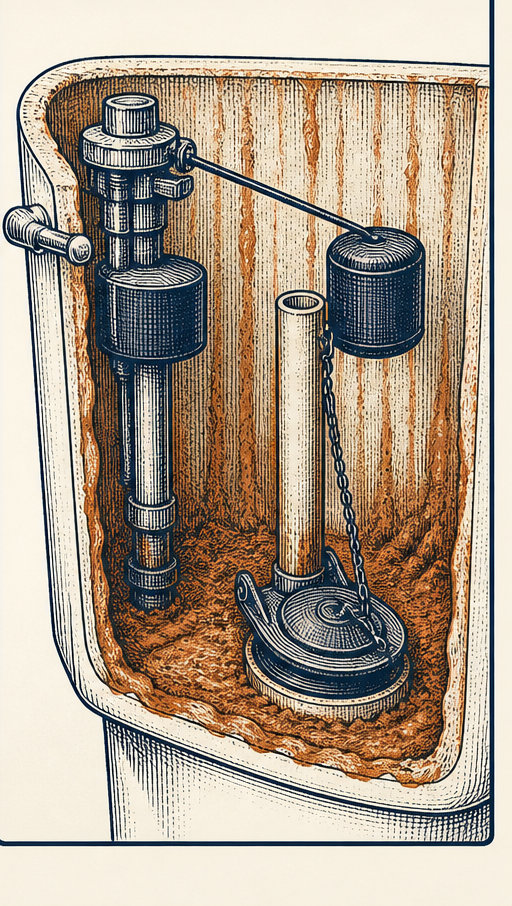
A teaching diagram, not a customer toilet tank. Dissolved iron leaves a hard ring. Iron bacteria leave jelly. Sulfur-reducing bacteria add a rotten-egg smell. Texture is the first split.
Hard ring
Dissolved iron
Orange or brown, no smear. Oxidizing iron filter conversation after a certified-lab iron number. Not a biofilm job.
Jelly or film
Iron bacteria
MDH: rust, cells, and slime stuck to pipes and fixtures. Not known to cause disease. Still test coliform and nitrate.
Slime plus eggs
Sulfur bacteria
Penn State: sulfur-reducing bacteria generate H₂S. Smell hot versus cold before you buy a tank.
Lift the lid off a toilet tank on a private well and you may find more than a rust ring: a rust-colored or gray jelly on the walls, stringy growth on the flapper chain, or a slick film that smears when you touch it. That texture is the clue. Dissolved iron stains; bacteria make slime. Minnesota Department of Health describes iron bacteria as organisms that combine iron (or manganese) and oxygen to form deposits of rust, bacterial cells, and “a slimy material that sticks the bacteria to well pipes, pumps, and plumbing fixtures.”
The toilet tank is simply where you notice it first: water sits still, it is exposed to air, and nobody scrubs it. This page is for private-well owners only. Public water systems are regulated and tested by the utility; call them instead. This site is not medical advice. If coliform or nitrate is present, take the sheet to the local health department.
Stain vs. slime: a 60-second read
| What you see | Most likely class | Next step |
|---|---|---|
| Hard orange/brown ring, no texture | Dissolved iron oxidizing — see orange stains | Iron + manganese + pH at a certified lab |
| Rusty, yellow, brown, or gray slime; feathery growth in standing water | Iron bacteria biofilm | Coliform + nitrate first; iron-bacteria confirmation if you need it |
| Black or gray slime with a rotten-egg smell | Sulfur-reducing bacteria (often with iron bacteria) | H₂S / sulfate; check hot vs. cold |
| Oily, rainbow sheen on standing water that breaks apart when poked | Iron bacteria film (MDH lists “rainbow colored, oil-like sheen”) | Same as slime |
| Pink/orange ring only at the waterline of the bowl, not the tank | Usually airborne bacteria, not a well problem | Clean and monitor |
MDH lists the smells to expect with iron bacteria as swampy, oily or petroleum, cucumber, sewage, rotten vegetation, or musty, and notes they may be stronger after water has sat unused.
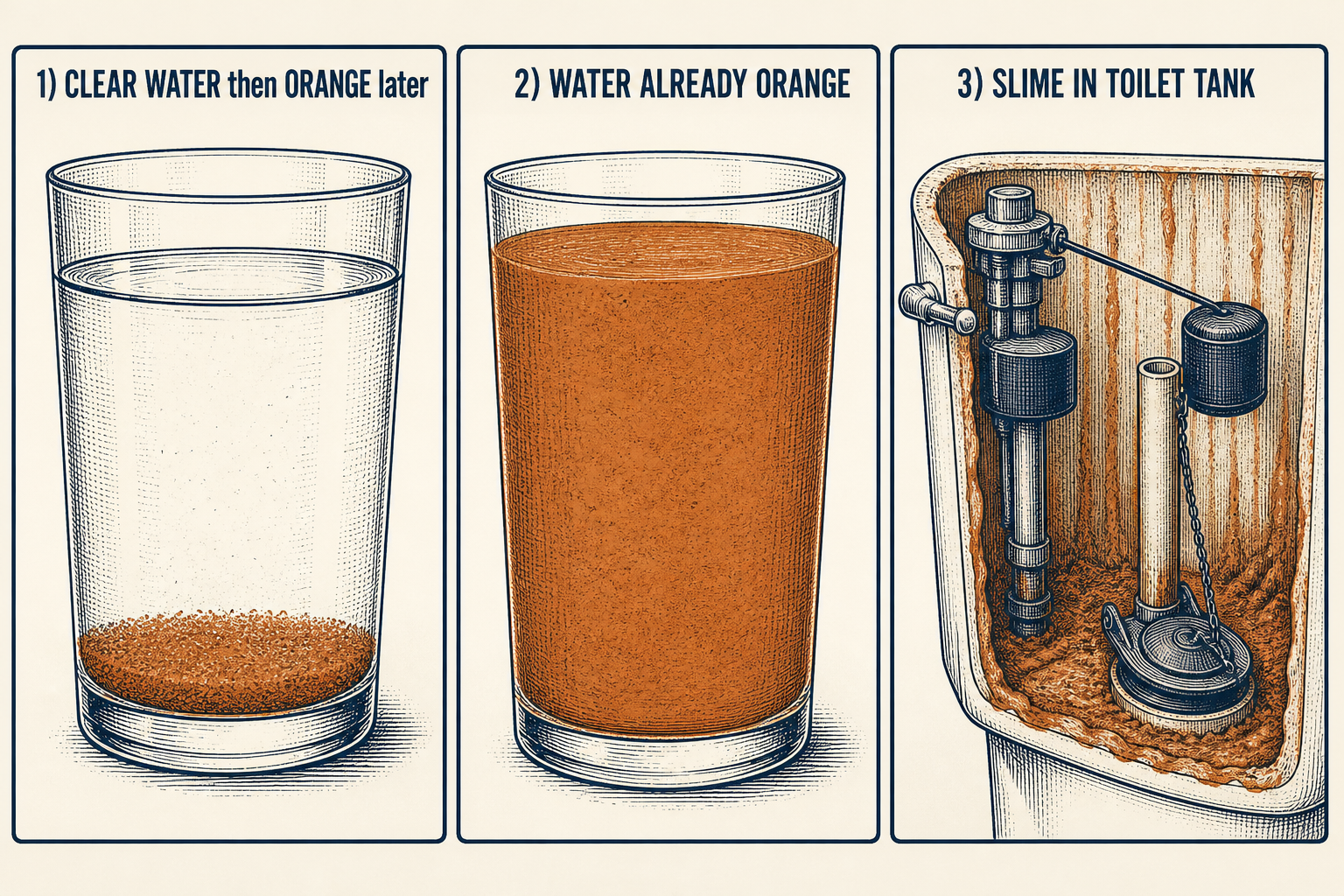
Four questions that narrow it down
- Color. Rust, orange, yellow, or brown slime points to iron bacteria. Black or dark gray, especially with odor, points toward sulfur-reducing bacteria and iron sulfide.
- Smell. Rotten eggs means hydrogen sulfide. Penn State Extension explains that sulfur-reducing bacteria in the well, groundwater, or plumbing generate H₂S.
- Hot vs. cold. If the odor is only on the hot side, the water heater is the usual suspect: Penn State notes that a magnesium anode rod can react with sulfate to produce H₂S. That is a water-heater fix, not a well fix. If both hot and cold smell or slime, the source is the well or the whole system. See rotten-egg smell in well water and Hydrogen Sulfide in Minnesota Well Water.
- Where it appears. Slime in every toilet tank, in the pressure-tank drain, or in a sediment-filter housing means the growth is system-wide. Slime in one fixture that is rarely used may be local stagnation.
A stain without texture is a dissolved-iron conversation. Slime is a biofilm conversation. Do not buy a taller oxidizing tank because the tank lid looked rusty.
Is it dangerous?
MDH says iron bacteria are not known to cause disease, but they “can create conditions where other disease-causing organisms may grow,” and they can clog the well and reduce yield. MDH’s advice: to be safe, test for nitrate and coliform bacteria and make sure the well is properly constructed, located, and maintained.
Slime is a sign that something is living in the water system. It does not prove the well is sanitary or unsanitary. Only a coliform test answers that question. This page will not turn a smear of jelly into a health score.
Test path
Step 1 — Coliform bacteria and nitrate. This is the safety test. Start at certified labs by state. If bacteria or nitrate fails, stop shopping filters. Call the health department.
Step 2 — The chemistry that feeds the slime. Iron, manganese, pH, hardness, sulfate, and hydrogen sulfide tell you which treatment class fits. EPA’s secondary guidance is 0.3 mg/L for iron and 0.05 mg/L for manganese. Those are public-system teaching numbers, not private-well legal limits. State chemistry: Iron in Minnesota, Iron in Wisconsin, Manganese in Minnesota. A stain without texture is still orange stains.
Tap Score / SimpleLab is a mail-in certified-lab kit example, not a ranked pick. Well Diagnosis may earn a commission if you buy through an approved affiliate link. See the disclosure. If coliform is present, call the health department.
Step 3 — Confirm iron bacteria if you need to. MDH notes you can confirm iron bacteria with a laboratory test. Most homeowners do not need this if the slime is obvious; it helps when you are paying a contractor for a well rehabilitation.
Read the results with how to read a well water lab report. Sample the untreated kitchen cold tap unless the lab says otherwise. A store strip is a screen. Well water test kits explains that split.
Fixes, in the order they usually happen
1. Shock chlorination (disinfect the well and plumbing). This is the most common first move. MDH says disinfectants — most often household laundry bleach — are the most common chemical treatment for iron bacteria, and recommends working with a licensed well contractor or following state disinfection instructions. MDH also cautions that a shock concentration should be near but not above 200 ppm, and warns against continuous chlorine injection into the well. Penn State’s shock-chlorination guide walks through the full procedure.
Expect regrowth. MDH is direct that eliminating iron bacteria “can be difficult and expensive” and treatment may only be partly effective. Heavily infected wells may need physical removal: the contractor pulls the pump, cleans it, and scrubs the casing, sometimes followed by professional acid or surfactant treatment. Never mix acid and chlorine.
UV vs. shock chlorination is the sister page for the one-time well job versus a house UV lamp.
2. Remove the food supply — an oxidizing iron/sulfur filter. If tests show iron, manganese, or H₂S, an oxidizing whole-house filter (air injection, chlorine or peroxide feed plus contact tank, or catalytic media) takes out what the bacteria live on and what stains the fixtures. Penn State notes oxidation systems need a backwashing filter and that aerators should be disinfected so bacteria don’t colonize them. Compare types in whole-house iron and sulfur filters and iron filter vs. water softener. A softener is not an iron-bacteria tank.
Manufacturer sites are catalogs, not rankings. SoftPro is an approved iron/sulfur catalog link (see the disclosure):
- SoftPro — iron/sulfur filters (not softeners)
SpringWell and other whole-house catalogs stay official URLs on this site unless a page already marks them approved.
3. UV as the last barrier — only on clear, pretreated water. A certified NSF/ANSI 55 Class A UV unit disinfects flowing water, but it does not remove iron, manganese, or H₂S, and slime and iron film on the quartz sleeve block the lamp. UV goes after the iron/sulfur filter, never instead of fixing the well. Details: UV vs. shock chlorination and treatment order after the pressure tank. Look the model up in the NSF drinking-water treatment-unit database. NSF is a claim on a listed model, not a badge this site awards.
4. Fix the well itself. MDH prevention points: cap the casing watertight at least 1 foot above ground, keep pumps and pipe off the ground during repairs, and disinfect after any service. Find a licensed contractor via NGWA. Verify state licensing yourself. NGWA does not guarantee the work.
Quick toilet-tank cleanup (cosmetic only)
Scrubbing the tank and flushing will make it look better for a while. It does nothing about the source. Do not drop chlorine tablets into a toilet tank; they can damage flappers and seals, and they mask the symptom you are trying to track.
Bottom line
A slimy toilet tank on a private well is almost always a biofilm story, not a dissolved-iron story. Test coliform and nitrate first, then iron, manganese, and sulfur. Shock the well if the health department or a contractor agrees, remove the iron or sulfur that feeds regrowth, and add Class A UV last if you want a barrier. Bacteria or nitrate still goes to the health department.
Updated 2026-10-10.
State pages and the labs hub
- Certified labs by state
- Iron in Minnesota Well Water
- Iron in Wisconsin Well Water
- Hydrogen Sulfide in Florida Well Water
- Hydrogen Sulfide in Minnesota Well Water
- Hydrogen Sulfide in Wisconsin Well Water
- Florida certified labs
- Minnesota certified labs
- Wisconsin certified labs
- Michigan certified labs
- North Carolina certified labs
Related
Sources
- 1.Minnesota Department of Health. Iron Bacteria in Well Water.
- 2.Penn State Extension. Hydrogen Sulfide (Rotten Egg Odor) in Water Wells.
- 3.Penn State Extension. Shock Chlorination of Wells and Springs.
- 4.Penn State Extension. Iron and Manganese in Private Water Systems.
- 5.U.S. EPA. Secondary Drinking Water Standards: Guidance for Nuisance Chemicals.
- 6.U.S. EPA. Private Drinking Water Wells.
- 7.CDC. Guidelines for Testing Well Water.
- 8.NSF. Search NSF Certified Drinking Water Treatment Units.
- 9.Wellowner.org / National Ground Water Association. Find a Contractor.