Guide · Updated October 14, 2026
Blue-Green Stains on a Private Well: Low pH and Copper Corrosion
Direct answer
Blue-green on porcelain is copper or brass leaving the pipe, usually because untreated pH is low. Get a short-hold pH plus first-draw and flushed copper — and lead if the solder is old — before anyone sells a calcite tank. Coliform or nitrate on the same sheet still goes to the local health department.
| What to test | Why | EPA MCL / SMCL or guidance |
|---|---|---|
| pH | CDC annual floor. Low pH is a corrosion clue, not an iron-filter job. | 6.5–8.5 SMCL (aesthetic guideline) EPA secondary standards |
| Copper | Blue-green stains with low pH. Pair with untreated pH and a first-draw metals sample. | 1.0 mg/L SMCL (aesthetic); 1.3 mg/L public-system action level EPA secondary standards |
| Lead | Usually a plumbing number. First-draw versus flushed changes the reading. | 0.015 mg/L public-system action level (15 ppb) EPA lead in drinking water |
| Total coliform | CDC’s annual floor for a private well. A present result is a pathway warning, not a shopping trip. | Present/absent — any detected coliform is a positive until a clean retest CDC well-testing guidelines |
| Nitrate as N | Same yearly panel as coliform. A result at or above the public-system line goes to the health department. | 10 mg/L as N (EPA public-system MCL) EPA National Primary Drinking Water Regulations |
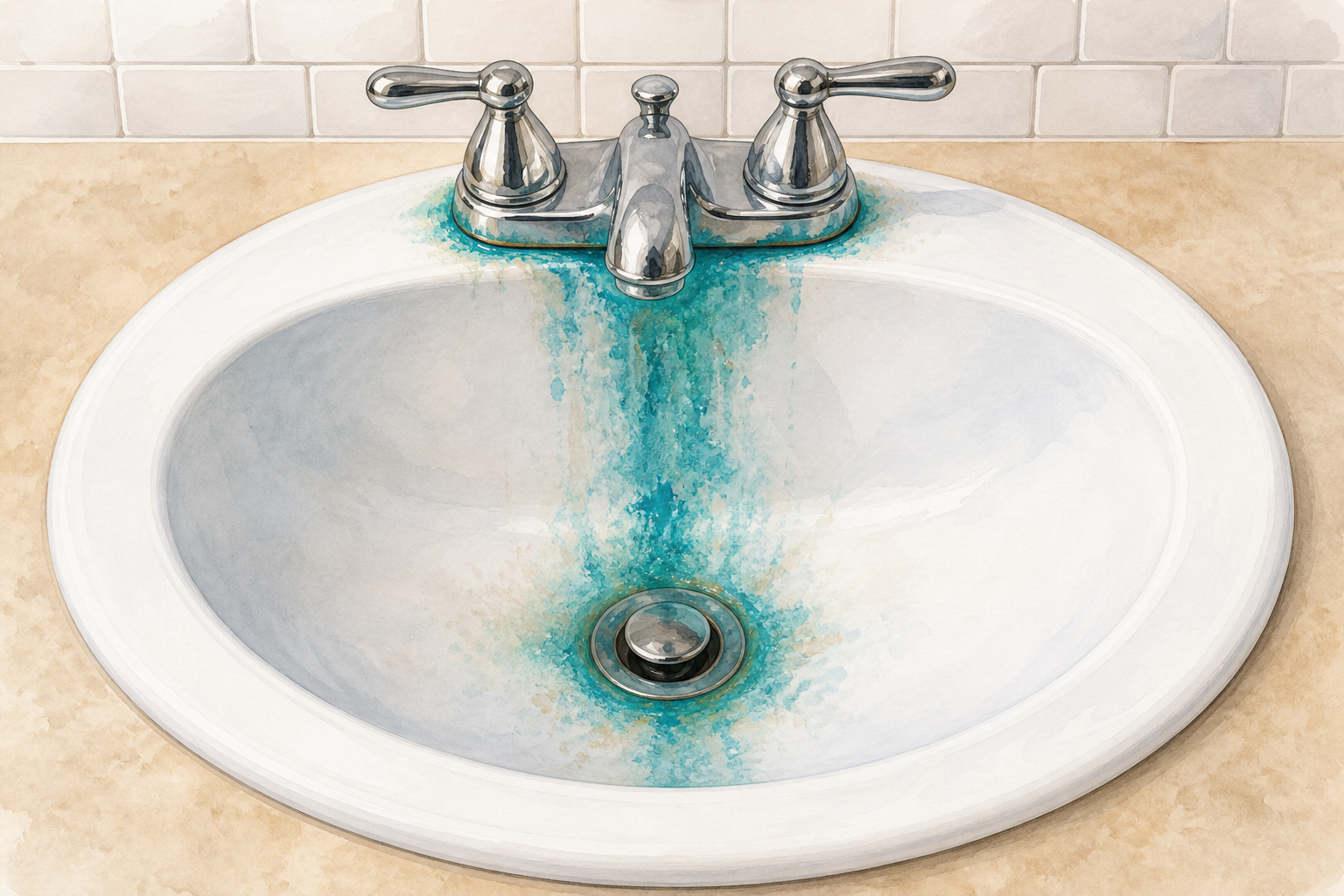
Blue-green is copper, not iron
A teaching diagram, not a customer kitchen. The stain is metal leaving the pipe. Compare untreated pH and two copper numbers — not a diagnosis and not a private-well legal limit.
What you see
Blue-green
Porcelain, chrome, or a toilet tank with turquoise film. Orange is iron. Slime is bacteria. Those are other pages.
What you compare
pH 6.5–8.5
EPA secondary pH range. Copper action level 1.3 mg/L is a public-system teaching number. First-draw and flushed both matter.
Treatment class
Neutralizer
Calcite in the mid-high 6s; calcite plus MgO near or below 6; soda-ash feed when a bed will not hold. Not an iron filter.
Blue-green on a porcelain sink, around a faucet base, or in a toilet tank is not rust. Rust is orange or brown. This stain is copper or brass coming off the plumbing because the water is acidic — low pH, low alkalinity, or both. An iron filter will not stop it. A softener will not add the alkalinity the pipe needs. The class is a pH / corrosivity job, not an iron job.
This page is for private-well owners only. Public water systems are regulated under the Lead and Copper Rule; call the utility. This site is not medical advice and will not turn a pH or a copper milligram into a health score. If coliform or nitrate is present, take the sheet to the local health department first.
What you are looking at
Connecticut DPH’s copper-in-private-wells page says copper can dissolve from copper pipes and brass fittings when the water is corrosive, and that blue-green stains on fixtures are a common clue. Virginia Cooperative Extension’s CORR 442-665 walks the same split: corrosive water attacks metal plumbing; the stain is the metal leaving the pipe. Alabama Extension ANR-1230 puts it in plumbing terms — low pH and low alkalinity raise corrosivity, and copper, brass, and galvanized lines pay first.
A metallic or bitter taste on first-draw water, pinhole leaks on copper, or a green film on chrome are the same family. Orange stains on the same sink are a different class — see orange stains in well water. Slime in the tank is bacteria, not copper — see slimy toilet tank. Do not buy one tank for all three.
What 6.5–8.5 and 1.3 mg/L mean — and what they are not
EPA’s secondary (aesthetic) standards list pH 6.5–8.5 as a guidance range for public systems. That is an SMCL, not a private-well legal limit. Water below about 6.5 is the usual corrosion conversation; water in the mid-to-high 6s can still dissolve copper if alkalinity is thin. This page does not treat 6.4 as a crisis or 6.6 as a pass.
EPA’s Lead and Copper Rule sets a public-water-system copper action level of 1.3 mg/L. Private wells are not under that Act. Do not call 1.3 mg/L a kitchen-tap statute. It is the comparison number people already know. Connecticut DPH uses that same 1.3 mg/L line when it talks about copper in private-well water. If the units are µg/L, convert: 1.3 mg/L = 1,300 µg/L. How to read a well water lab report is the decoder.
A first-draw copper that sits above 1.3 mg/L and a flushed sample that drops is plumbing, not the aquifer. A flushed sample that stays high can still be the well or a long copper run. Sample both before you shop.
If the house has old solder or you have any reason to worry about lead, put lead on the same sheet as pH and copper. Lead is not an aesthetic stain. Do not treat a lead detect as a fixture-cleaning project.
What to put on the lab form
Minimum useful panel when the complaint is blue-green:
- pH, untreated, as soon as the lab allows (pH drifts in a mailed bottle — ask about a field pH or a short hold)
- Copper, first-draw (after the water has sat 6 hours or overnight) and flushed
- Alkalinity and hardness
- Lead if plumbing is old, soldered, or you cannot date the lines
- CDC’s annual private-well backbone: total coliform, nitrate, TDS, and pH
Sample the untreated kitchen cold tap unless the lab says otherwise. Sampling after a neutralizer that is already in the basement tells you the tank lost, not what the well sent. A store pH strip is a screen. Well water test kits explains that split. Start the official search at certified labs by state. Lead at the tap is usually plumbing — Lead in Pennsylvania Well Water and Lead in Wisconsin Well Water. The lab inventories for those states are Pennsylvania and Wisconsin. The same official-search path now covers Michigan and North Carolina.
Tap Score / SimpleLab is an approved class example of a mail-in certified-lab kit, not a ranked pick (Awin tracked URL). Well Diagnosis may earn a commission if you buy through an approved affiliate link on this page. That does not change the price you pay. See the disclosure. Confirm pH, copper, alkalinity, and the annual coliform/nitrate pair on the order form. Bacteria or nitrate still goes to the health department.
If the pressure tank is short-cycling or feels waterlogged, fix that first — pressure tank waterlogged. A dying bladder will fake stain and metal problems you do not have.
After the sheet: classes, not a catalog
Name the class after you have untreated pH, alkalinity, and the two copper numbers. Then look a model up in the NSF drinking-water treatment-unit database. NSF is a claim on a listed model, not a badge this site awards. This page does not rank brands.
Whole-house classes people ask about for low-pH copper:
- Calcite (calcium carbonate) neutralizer when pH sits in the mid-to-high 6s and alkalinity is only a little thin. The bed dissolves into the water, raises pH and hardness, and needs periodic media refill. Virginia CORR 442-665 and Alabama ANR-1230 both treat calcite as the usual first class in that range.
- Calcite plus magnesium oxide (MgO / “corosex”) blend when pH is around or below 6. MgO raises pH faster; too much of it overshoots. A licensed installer sizes the blend. This is still a dissolving-media bed, not a filter cartridge.
- Soda-ash (sodium carbonate) feed when pH is lower still, flow is large, or a dissolving bed will not hold. A chemical feed pump doses into a contact tank after the pressure tank. That is a different class from a calcite pot.
An iron filter or a water softener will not fix blue-green stains. Softening can make corrosive water more aggressive if you strip hardness and add nothing back. Carbon “for taste” does not add alkalinity. Do not buy a pitcher “for copper” and call the house done.
Point-of-use options for drinking and cooking only — they do not protect the pipes:
- Reverse osmosis (often NSF/ANSI 58) or distillation at the kitchen sink
- Copper-selective ion exchange where the sheet and an installer say it fits
Those cut copper at one tap. They do not stop pinholes in the basement. If you treat the house, sediment first, then the pH class, then a softener last if hardness remains — treatment order after the pressure tank. Retest pH and copper after the tank is in. A calcite bed that runs empty is just a gravel filter.
If bacteria is present, stop. Health department first. A neutralizer on a contaminated well is the wrong Monday.
What to do this week
- Confirm the stain is blue-green or turquoise, not rust-orange and not slime. Orange: iron. Slime: toilet tank.
- Order untreated pH, first-draw copper, flushed copper, alkalinity, hardness, plus coliform and nitrate. Add lead if the solder or the age of the house says so.
- Put pH next to 6.5–8.5 and copper next to 1.3 mg/L as teaching numbers, not private-well legal limits. Convert µg/L first.
- If bacteria or nitrate is flagged, call the health department before you shop a calcite tank.
- Only after the sheet: calcite vs. calcite/MgO vs. soda-ash feed. Drinking-only RO is a tap, not a house.
Bottom line
Blue-green on a private-well fixture is copper or brass leaving the pipe, usually because the water is acidic. It is not iron. Get untreated pH and two copper numbers from a certified lab. Compare pH to EPA’s secondary 6.5–8.5 range and copper to the public-system 1.3 mg/L action level — as teaching numbers, not kitchen-tap statutes. Treatment class is a calcite or calcite/MgO neutralizer, or a soda-ash feed, after the pressure tank. An iron filter or a softener is the wrong class. Bacteria and nitrate still go to the health department.
Updated 2026-10-10.
State pages and the labs hub
Related
Sources
- 1.U.S. EPA. Secondary Drinking Water Standards: Guidance for Nuisance Chemicals.
- 2.U.S. EPA. Lead and Copper Rule (public-system action level 15 ppb).
- 3.U.S. EPA. Private Drinking Water Wells.
- 4.CDC. Guidelines for Testing Well Water.
- 5.Connecticut Department of Public Health. Copper in Private Drinking Water Wells.
- 6.Virginia Cooperative Extension. Corrosive Water Problems (CORR 442-665).
- 7.Alabama Cooperative Extension System. Water Corrosivity and Your Plumbing System (ANR-1230).
- 8.NSF. Search NSF Certified Drinking Water Treatment Units.